
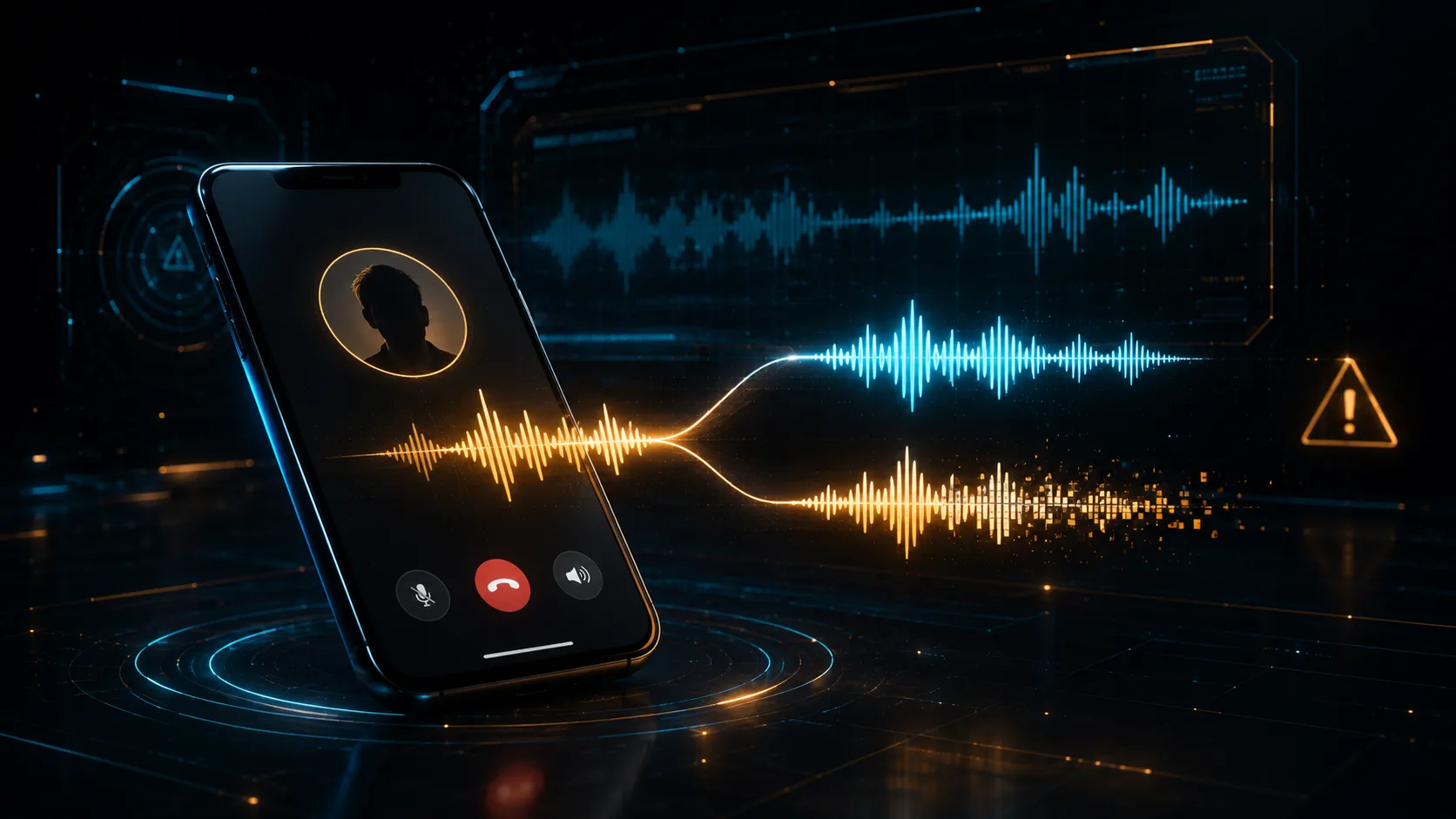
"My child is in trouble and needs money": is that call really them?
Contact your bank, payment provider, or exchange immediately and ask if the payment can be stopped or traced – speed matters here.
A familiar voice is no longer proof of who's calling. Here's how to verify a family emergency before you send a cent.
The voice on the phone sounds exactly like your child, your partner, or your parent – crying, talking fast, saying they can't explain everything right now. The story might involve a car crash, an arrest, a stolen phone, or an unpaid hospital bill, and it almost always ends the same way: send money immediately, and don't tell anyone. That voice could be genuine. It could also be an impersonator, a replayed recording, or audio generated by AI.
Voice-cloning tools can now produce convincing speech from just a few seconds of audio pulled from social media videos, voice notes, livestreams, or old phone calls. The FTC warned in 2023 that scammers were adding AI voice cloning to classic "family emergency" schemes, and the FBI has separately warned that criminals increasingly use AI-generated voice and video to make fraud more convincing. The takeaway is blunt: a familiar-sounding voice is no longer reliable proof of who's calling.
How the scam actually works
A scammer doesn't need a perfect clone to succeed. Some research the family online, grab a public voice sample, and generate a short synthetic message. Others skip the technology almost entirely – background noise, crying, and a bad connection are often enough to hide inconsistencies in an impersonator's voice. A second criminal frequently joins the call posing as a lawyer, police officer, or doctor to add pressure without adding any real verification.
The pattern repeats across almost every version of this scam: a plausible emergency creates fear, the caller gives the victim no time to think, secrecy is demanded, payment has to use a method that's fast and hard to reverse, and the victim is kept on the line specifically to prevent them from checking the story elsewhere.
This particular version of the family-emergency scam tends to target older relatives especially hard, since urgency combined with unfamiliar technology makes the story harder to question in the heat of the moment. That doesn't mean anyone else is immune: the same tactics work on anyone who picks up an unexpected call framed as a crisis. The safest mental model is to treat the voice itself as unverified information, no different from an unsigned note, until it's confirmed through a channel the caller has no control over.
Warning signs
- You're told not to contact anyone else about it – isolation is the point
- Payment has to happen right now, usually by wire transfer, gift cards, cryptocurrency, cash courier, or an unfamiliar account
- The caller avoids answering specific personal questions
- Caller ID shows the right name or number – that proves nothing, since caller ID can be spoofed
- A second "authority figure" takes over the call and adds pressure but never actually verifies anything
What to do during the call
Stay calm and buy yourself time. Say you need a moment, hang up, and call the relative back on a number already saved in your contacts, not one the caller gave you. If they don't answer, try their spouse, a close friend, or their workplace. Ask a question only they would know the answer to, ideally a private memory or a prearranged safe word, never something that could be found on social media. Never call a number the suspicious caller supplied, and never read a one-time passcode out loud to anyone on the phone.
If you already sent money
Contact your bank, payment provider, or exchange immediately and ask whether the payment can be stopped, recalled, or traced – speed matters here. Preserve call logs, phone numbers, text messages, and any receipts. Report the incident to local law enforcement, and in the US to ReportFraud.ftc.gov and the FBI's IC3.gov. If you shared any passwords or credentials during the call, change them. Be especially wary afterward of "recovery experts" who contact you offering to get the money back for an upfront fee – that's a common second-stage scam targeting people who already lost money once. Filing a report quickly also matters beyond your own case: it helps investigators connect patterns across victims, which is often how these operations eventually get disrupted.
How to prepare before it happens
Review which of your own voice and video clips are public – anything posted openly can theoretically be reused. Tighten privacy settings on social media where practical. Most importantly, agree on a family protocol in advance: hang up and call back, use a safe word nobody would post online, and always confirm through a second person before acting. Synthetic voices will keep getting better, so don't rely on trying to detect a "robotic" sound. The durable defense is independent verification through a channel the scammer doesn't control, not judging the audio by ear.
It's worth having this conversation with relatives who might be targeted specifically, rather than assuming everyone already knows what to do. A short, calm discussion about the safe word and the "hang up and call back" rule, done well before any emergency happens, is far more effective than trying to remember the right steps for the first time while panicked on the phone.
Variants you'll run into
The cloned-voice emergency call is really a family of scams, and knowing the siblings makes each one easier to spot. The classic is the grandparent bail call: a "grandchild" has been arrested after a minor accident, is embarrassed, and a "public defender" gets on the line to collect bail by wire or gift cards. A darker cousin is the virtual kidnapping call, where screaming in the background and a threatening voice demand an immediate ransom while insisting you stay on the line: the entire script is designed to stop you from calling the supposed victim, who is usually safe at school or work.
Not every variant arrives as a live call. Scammers increasingly send a cloned voice note over WhatsApp or text: "Mom, my phone broke, this is my new number, I need help paying something" – because a short recorded clip hides flaws better than a live conversation and the new-number story explains why your saved contact isn't ringing. In the workplace version, the "relative" is replaced by your boss or a company executive asking an employee to rush a payment or buy gift cards for clients; the psychology is identical, only the authority figure changes. Whatever the wrapper, the skeleton never changes: urgency, secrecy, and an irreversible payment method.
A realistic walkthrough: Ruth's Tuesday afternoon
Ruth, 62, a retired teacher, is folding laundry when her phone rings from an unknown number. The voice is unmistakably her son's – shaky, congested, talking over traffic noise. "Mom, I rear-ended someone, the other driver is hurt, please don't tell Dad." Before she can ask anything, a calm second voice introduces himself as the attorney handling the case. He explains that a $4,800 "release processing fee" paid within the hour keeps the incident off her son's record, and that gift cards from the pharmacy down the street are the fastest accepted method.
Ruth's heart is pounding, but one detail snags: her son always calls her "Ma", never "Mom". She tells the attorney she needs to get her purse, puts the phone down without hanging up, and uses the kitchen tablet to message her son on the number saved in her contacts. He replies in seconds – he's at his desk at work, completely fine. When she returns to the call and says so, the line goes dead instantly. The lesson she now repeats to her friends: the pause is the whole defense. Nothing in a real emergency is ruined by taking ninety seconds to check on a second device, and everything in a fake one falls apart.
Prevention that goes beyond the basics
Beyond the safe word and the call-back habit, a few concrete settings shrink your family's exposure. Replace personalized voicemail greetings with the carrier's default robotic message – your outgoing greeting is a free, clean voice sample available to anyone who dials your number. On social media, set old videos, reels, and tagged clips of family members to private where possible, and think twice before posting children's voices publicly at all. On the phone itself, enable your carrier's or handset's unknown-caller screening so unexpected numbers go to voicemail first; a scammer working a live script rarely leaves a message that survives a calm second listen.
Then make the human layer explicit. Agree with your family that no money request is ever acted on from a single phone call: it always requires confirmation by a second channel or a second person, no exceptions, even when the caller says there's no time. Brief the relatives most likely to be targeted – grandparents, whoever handles the family finances, a teenager with a public profile – and rehearse the response once out loud: "I'm going to hang up and call you back." Finally, talk to your bank about daily transfer limits or a cooling-off delay on new payees; a scam that needs money moved in twenty minutes dies quietly against a 24-hour hold.
Quick checklist
- Hang up and call back on a number you already have saved
- Never send money based on a call alone, no matter how urgent it sounds
- Ask a private question or safe word, not something postable online
- Confirm with a second family member before acting
- Never read a verification code aloud to anyone
- Report immediately if you've already paid – speed matters for recovery
Frequently asked questions
How much audio is needed to clone a voice?
Can I trust the call if caller ID shows the right number?
What should a safe verification question look like?
Daniel A. and Óscar S. run Breachfolio, a small independent site about security and AI. This article was drafted with AI assistance and reviewed by a person before it went live. We write from documentation, vendor sources and published research rather than from original lab benchmarks, and we link a source in the sentence that relies on it. How we work · About us